CogAdapt: Adapting Clinical ECG Foundation Models for Wearable Cognitive Load Assessment
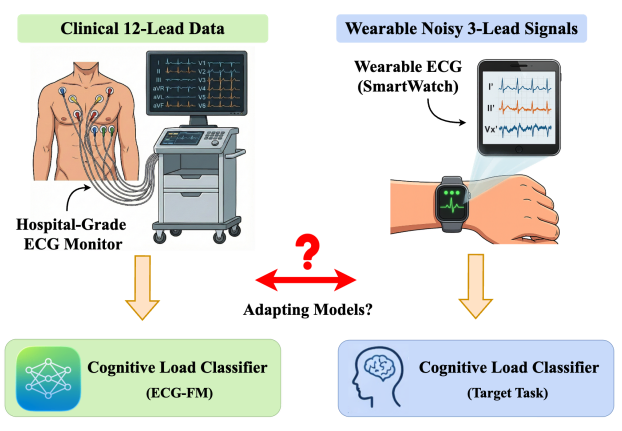
The Sensor Gap
Clinical ECG foundation models expect 12-lead hospital recordings. Wearable cognitive load datasets provide noisy 3-lead signals and a different task.
Abstract
Assessing cognitive load continuously and at low latency would help adaptive human-computer interaction, but it remains hard because labeled data are scarce and models generalize poorly across subjects. Recent ECG foundation models, pre-trained on millions of clinical diagnostic ECG recordings, yet they do not apply directly to wearable devices when the sensor configuration and the task both differ. We present CogAdapt, a framework that adapts a clinical ECG foundation model to wearable cognitive load assessment. CogAdapt has two parts. LeadBridge is a learnable adapter that maps 3-lead wearable signals to a 12-lead-compatible representation. ProFine is a progressive fine-tuning strategy that unfreezes encoder layers in stages while limiting representational drift in the pre-trained model. On two public datasets (CLARE and CL-Drive) under leave-one-subject-out cross-validation, CogAdapt reaches macro-F1 of 0.626 and 0.768, improving over from-scratch baselines by 11.2 and 16.1 percentage points. The results show that a clinical ECG pretraining can support subject-independent cognitive load assessment from wearable sensors.
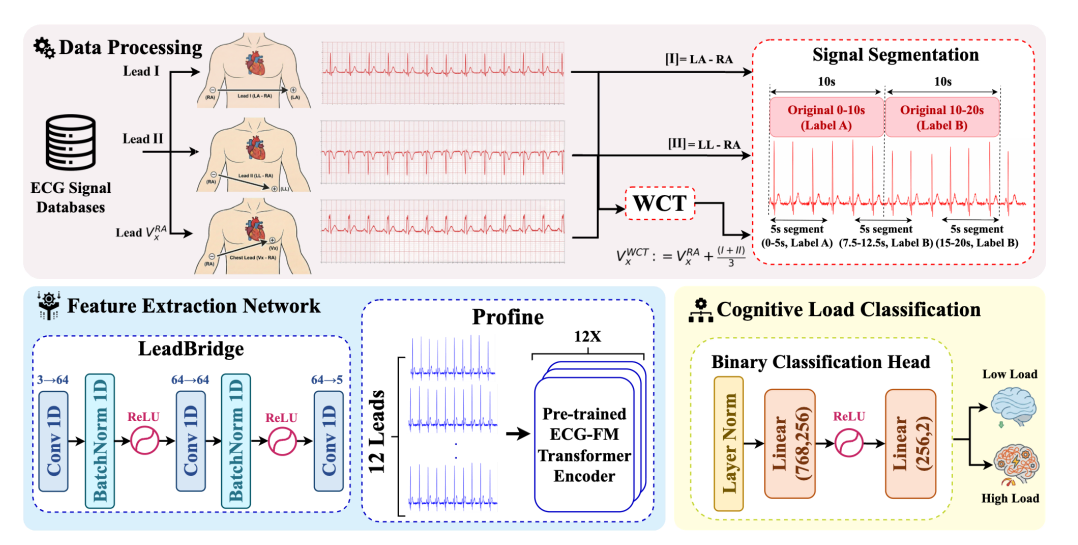
CogAdapt Pipeline
Wearable preprocessing, LeadBridge 3→12 mapping, pretrained ECG-FM, and a binary load head.
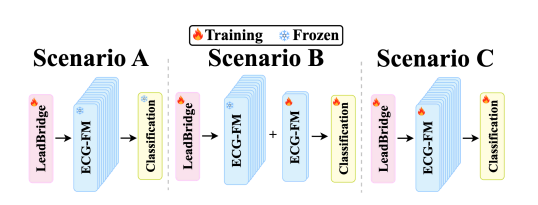
ProFine Progressive Fine-Tuning
Three scenarios control how much of ECG-FM is updated: frozen, top layers, or full encoder with bucketed learning rates.
Main Results
Performance on CLARE and CL-Drive under K-fold and LOSO. Cells are mean ± std over folds. Best per column in bold.
| Method | CLARE | CL-Drive | ||||||||||
|---|---|---|---|---|---|---|---|---|---|---|---|---|
| K-Fold | LOSO | K-Fold | LOSO | |||||||||
| Acc ± std | F1 ± std | AUC | Acc ± std | F1 ± std | AUC | Acc ± std | F1 ± std | AUC | Acc ± std | F1 ± std | AUC | |
| ECG-LightCNN | .774±.007 | .726±.009 | .832 | .735±.136 | .514±.044 | .539 | .814±.017 | .808±.018 | .887 | .716±.114 | .607±.093 | .707 |
| Transformer | .706±.012 | .643±.011 | .718 | .640±.116 | .496±.044 | .506 | .688±.014 | .680±.013 | .731 | .617±.102 | .541±.086 | .604 |
| HRV-RF | .756±.011 | .688±.016 | .795 | .668±.167 | .444±.065 | .517 | .768±.013 | .758±.014 | .835 | .594±.137 | .533±.123 | .672 |
| CogAdapt-A | .742±.012 | .717±.010 | .843 | .681±.122 | .527±.052 | .598 | .823±.018 | .821±.018 | .906 | .665±.166 | .578±.149 | .705 |
| CogAdapt-B | .762±.012 | .736±.012 | .857 | .691±.127 | .557±.085 | .706 | .833±.019 | .831±.019 | .919 | .770±.073 | .704±.099 | .811 |
| CogAdapt-C | .813±.033 | .785±.034 | .898 | .736±.104 | .626±.119 | .799 | .862±.025 | .860±.025 | .945 | .831±.091 | .768±.117 | .889 |
LeadBridge Ablation
Frozen encoder (Scenario A). Only the 3→12 mapping and head are trained. LeadBridge wins on macro-F1 for both datasets.
| 3→12 Mapping | CLARE | CL-Drive | ||
|---|---|---|---|---|
| F1 | AUC | F1 | AUC | |
| Zero-padding | .380 | .639 | .519 | .764 |
| Random adapter | .409 | .548 | .516 | .704 |
| Dower transform | .407 | .628 | .508 | .744 |
| LeadBridge | .527 | .598 | .578 | .705 |
PTB-XL Reconstruction
Held-out PTB-XL reconstruction for precordial leads V2–V6. LeadBridge leads on RMSE for V2–V5 and on correlation for most leads.
| Lead | RMSE ↓ (µV) | Correlation ↑ | ||||
|---|---|---|---|---|---|---|
| Dower | Lin. Reg. | LeadBridge | Dower | Lin. Reg. | LeadBridge | |
| V2 | 205.69 | 195.08 | 175.61 | 0.546 | 0.546 | 0.669 |
| V3 | 290.39 | 194.52 | 189.77 | 0.569 | 0.570 | 0.613 |
| V4 | 270.63 | 164.72 | 164.02 | 0.662 | 0.698 | 0.718 |
| V5 | 215.06 | 143.45 | 140.76 | 0.679 | 0.694 | 0.717 |
| V6 | 161.40 | 129.66 | 135.22 | 0.544 | 0.549 | 0.547 |
Takeaways
- Clinical ECG pretraining can transfer to wearable cognitive load when the sensor gap is closed with a learned lead adapter.
- LeadBridge beats zero-padding, random adapters, and fixed Dower transforms on LOSO macro-F1 under a frozen encoder.
- Progressive unfreezing (ProFine) improves monotonically from A → B → C; full adaptation yields the strongest subject-independent results.
- Cross-dataset transfer still drops, so environment and label physiology remain open challenges.
BibTeX
@misc{mousavi2026cogadapt,
  author={Mousavi, Amir and Nourbakhsh, Erfan and Sirjani, Mohammad Sadegh and Slavin, Rocky and Xie, Mimi and Neely, Leslie and Davis, John and Quarles, John},
  title={CogAdapt: Adapting Clinical ECG Foundation Models for Wearable Cognitive Load Assessment},
  year={2026},
  eprint={2605.22774},
  archivePrefix={arXiv},
  primaryClass={cs.LG},
  url={https://arxiv.org/abs/2605.22774},
  note={Accepted at IEEE EMBS BHI 2026}
}