Controller Placement in Software-Defined Networks Using Reinforcement Learning and Metaheuristics
Where Should the Controllers Go?
Software-defined networks move all control logic into controllers, so how many controllers a network has, and which switches each one manages, sets its latency, load balance, and energy use. Finding that placement is NP-hard, and prior work rarely optimizes all of these objectives together.
Abstract
Software-defined networking (SDN) has revolutionized network management by enabling dynamic control and optimization of network resources. A key challenge in SDN deployment is the strategic placement and assignment of controllers, which significantly affects network performance in terms of energy consumption, latency, and load balancing. This research addresses the controller placement problem by proposing a two-step method that combines enhanced reinforcement learning with an improved metaheuristic algorithm, termed Bedbug-GLA. In the first step, an irregular cellular learning automata model is developed to determine the optimal number of controllers required. In the second step, the Bedbug metaheuristic algorithm is employed to efficiently assign controllers to switches. Simulation results demonstrate that Bedbug-GLA achieves up to an 18% improvement in maximum controller load, a 69% reduction in congested controller overload, and a 20% decrease in energy consumption compared to state-of-the-art metaheuristic approaches, as evaluated on standard network topologies derived from real-world datasets.
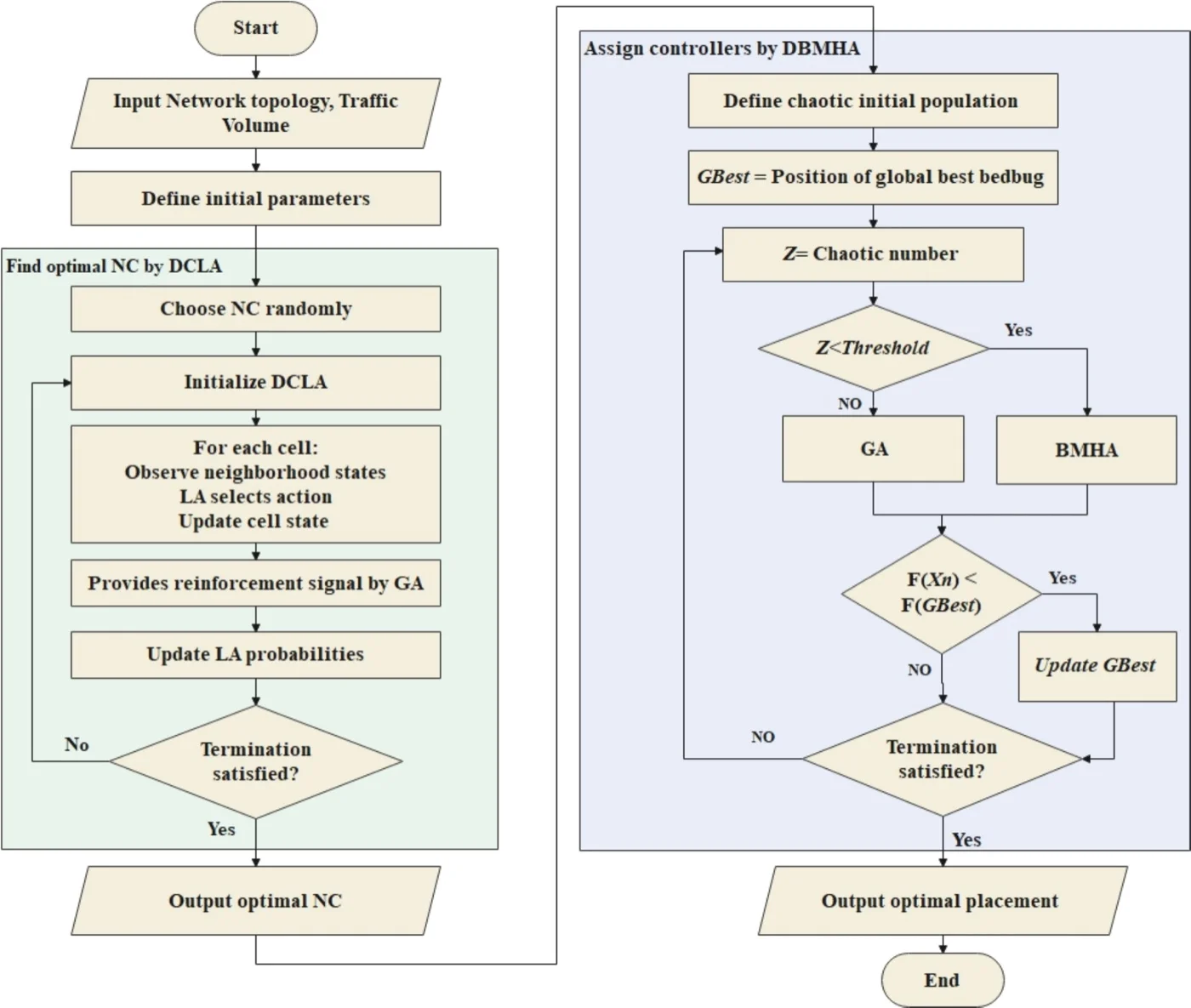
Bedbug-GLA in Two Steps
Bedbug-GLA first learns how many controllers the network needs, then decides which switches each controller manages.
| Step | Method | Output |
|---|---|---|
| Step 1 | DCLA: irregular cellular learning automata with a GA-derived reinforcement signal | Number of controllers |
| Step 2 | DBMHA: Bedbug metaheuristic with genetic operators and a chaotic initial population | Controller-to-switch assignment |
- DCLA. Each cell of the cellular learning automata observes its neighborhood, selects an action, and adapts from feedback. A genetic algorithm supplies the reinforcement signal to speed up learning.
- Choosing the number of controllers. DCLA sizes the controller set to the network's size, structure, traffic, and controller workloads.
- DBMHA. Genetic crossover and mutation help the Bedbug algorithm escape local optima, and a chaotic map diversifies the initial population.
- Multi-objective assignment. A weighted fitness function balances controller load, propagation latency, and energy usage.
Real-World Topologies
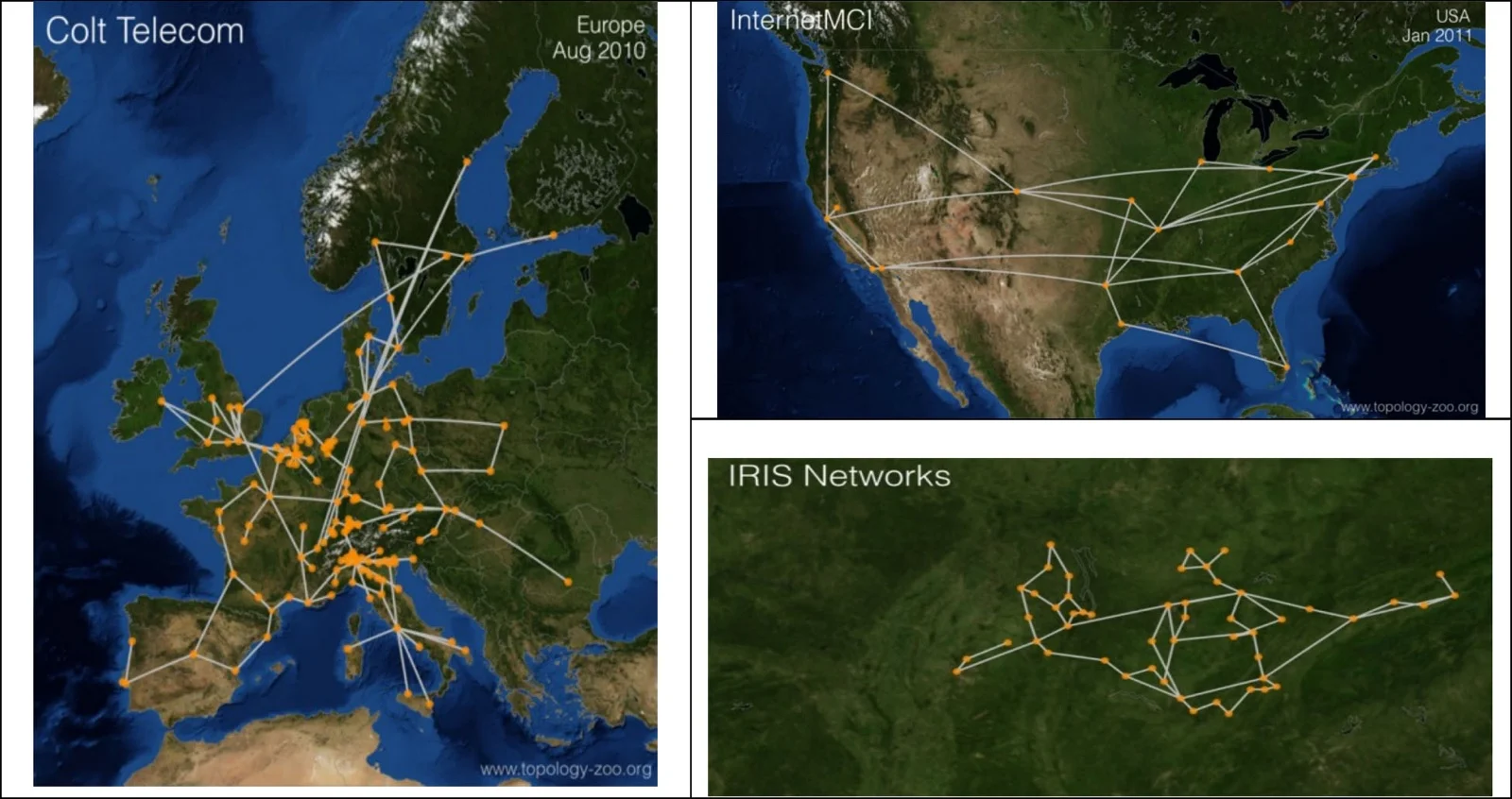
Bedbug-GLA is evaluated on three topologies from the Internet Topology Zoo with 3, 4, and 5 controllers, against PSO, ALO, GEWO, and BMHA. Traffic between random origins and destinations varies from 0 to 500 packets.
| Network | Extent | Location | Switches | Links |
|---|---|---|---|---|
| Internet2 OS3E | Country | USA | 34 | 42 |
| IRIS | Region | Tennessee, USA | 51 | 64 |
| Colt | Continent | Europe | 153 | 177 |
| Parameter | Value |
|---|---|
| Initial population | 30 |
| Run time | 30 iterations |
| Traffic | Random (0, 500) |
| e_base | 0.1 |
| e_dyn | 0.001 |
| e_trans | 1 |
| l_i | 1 |
| α, β (DCLA) | 0.01 |
| ε̂ (BMHA) | 0.185 |
| MinVar, MaxVar (BMHA) | 0, 1 |
| Search agents (ALO) | 40 |
| r1, r2 (PSO, GEWO) | Random in [0, 1] |
| c1', c2' (PSO) | 1.7, 2 |
| Inertia weight (PSO) | 0.75 |
Results
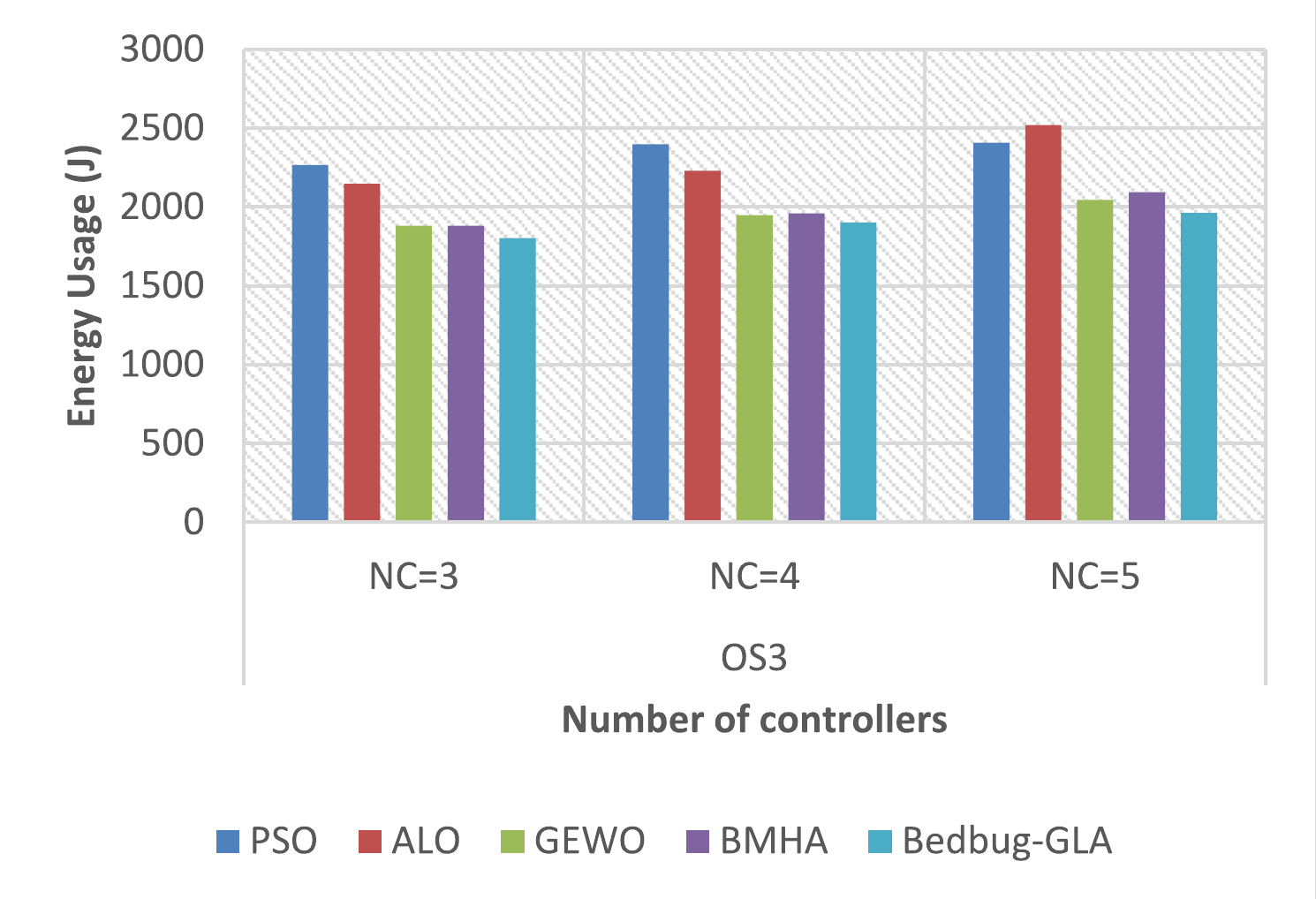
On Internet2 OS3E, averaged over 100 runs and 3–5 controllers, Bedbug-GLA has the lowest energy usage, maximum controller load, and congested-controller overload.
| Method | Energy (J) | Max controller load | Congested overload |
|---|---|---|---|
| PSO | 2356.74 | 1493.33 | 393.33 |
| ALO | 2297.64 | 1357.00 | 257.00 |
| GEWO | 1957.51 | 1273.33 | 143.33 |
| BMHA | 1977.16 | 1266.67 | 166.67 |
| Bedbug-GLA | 1888.86 | 1221.00 | 121.00 |
| vs. | Energy | Max controller load | Congested overload |
|---|---|---|---|
| PSO | 19.85% | 18.24% | 69.24% |
| ALO | 17.79% | 10.02% | 52.92% |
| GEWO | 3.51% | 4.11% | 15.58% |
| BMHA | 4.47% | 3.61% | 27.40% |
Takeaways
- Splitting controller placement into sizing (DCLA) and assignment (DBMHA) lets each step use the method that suits it.
- Genetic operators and chaotic initialization keep the Bedbug search diverse and help it avoid premature convergence.
- On Internet2 OS3E, Bedbug-GLA improves maximum controller load by 4%–18%, congested-controller overload by 16%–69%, and energy usage by 4%–20% over PSO, ALO, GEWO, and BMHA.
- ALO reaches the lowest end-to-end delay; Bedbug-GLA stays comparable on latency while using much less energy, trading a little delay for a balanced multi-objective result.
BibTeX
@article{Sirjani2025,
  author={Sirjani, Mohammad Sadegh and Maleki, Ali and Pakmehr, Amir and Abedini Bagha, Maedeh and Ghaffari, Ali and Pour Haji Kazem, Ali Asghar},
  title={Controller placement in software-defined networks using reinforcement learning and metaheuristics},
  journal={Cluster Computing},
  year={2025},
  month={9},
  day={3},
  volume={28},
  number={10},
  pages={660},
  abstract={Software-defined networking (SDN) has revolutionized network management by enabling dynamic control and optimization of network resources. A key challenge in SDN deployment is the strategic placement and assignment of controllers, which significantly affects network performance in terms of energy consumption, latency, and load balancing. This research addresses the controller placement problem by proposing a two-step method that combines enhanced reinforcement learning with an improved metaheuristic algorithm, termed Bedbug-GLA. In the first step, an irregular cellular learning automata model is developed to determine the optimal number of controllers required. In the second step, the Bedbug metaheuristic algorithm is employed to efficiently assign controllers to switches. Simulation results demonstrate that Bedbug-GLA achieves up to an 18% improvement in maximum controller load, a 69% reduction in congested controller overload, and a 20% decrease in energy consumption compared to state-of-the-art metaheuristic approaches, as evaluated on standard network topologies derived from real-world datasets.},
  issn={1573-7543},
  doi={10.1007/s10586-025-05331-y},
  url={https://doi.org/10.1007/s10586-025-05331-y}
}