Data Mining and Cloud Computing for Customer Pattern Analysis and Value Maximization
Keeping the Customers Who Matter
Companies hold large volumes of customer data but struggle to turn it into decisions about who to acquire, retain, and upsell. Pairing cloud computing with data mining makes it practical to find those patterns at scale.
Abstract
In the contemporary business landscape, companies are seeking efficient methods to analyze customer behavior and extract actionable insights to foster customer relationships and drive business growth. This paper presents a novel approach that combines the strengths of cloud computing, software engineering, and data mining techniques to analyze customer patterns and optimize the value of the customer life cycle. By employing data mining techniques, including clustering, classification, association analysis, and predictive modeling, businesses can identify customer patterns and behaviors. Through the extensive analysis of customer data, organizations can uncover concealed patterns, preferences, and trends, which facilitate informed decisions regarding customer acquisition, retention, upselling, and personalized marketing strategies, ultimately maximizing the value of the customer life cycle. The integration of cloud computing, software engineering, and data mining enables businesses to leverage advanced analytics and extract valuable insights from customer data. This approach enables organizations to gain a comprehensive understanding of customer patterns and behaviors, thereby facilitating targeted marketing campaigns, personalized customer experiences, and improved customer satisfaction.
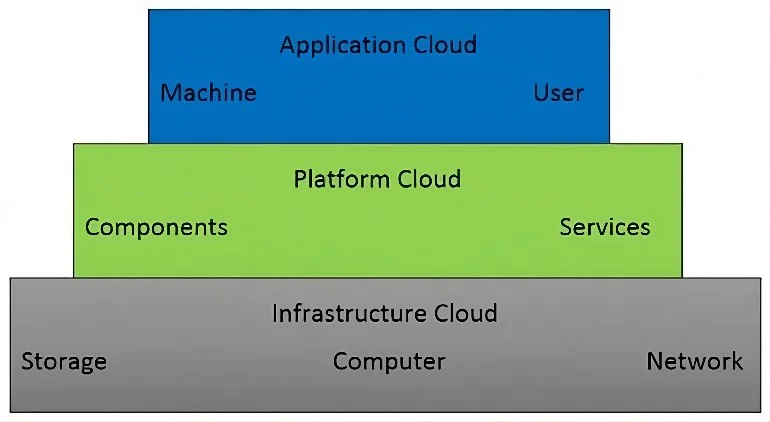
Cloud Computing Layers
Infrastructure, platform, and application clouds supply the storage, compute, and services that let data mining algorithms run on large customer datasets.
From Churn to Lifetime Value
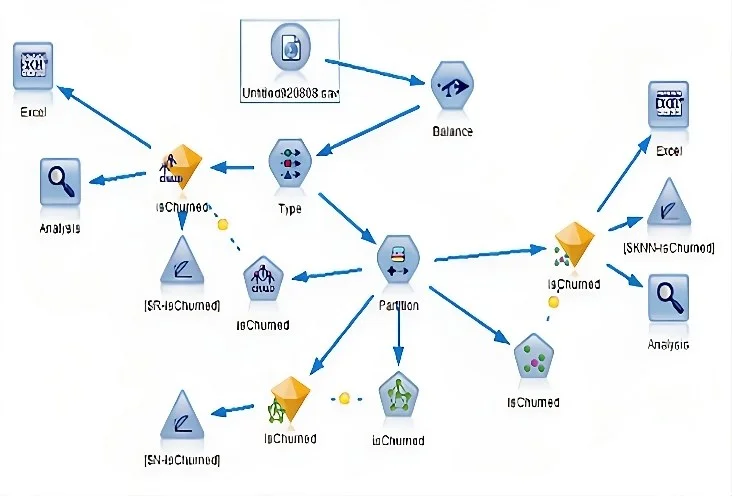
The analysis runs in three stages on real customer data from an insurance organization. Churners are rare, so the churn class is oversampled to a 1:2 ratio, giving 5,711 samples of which 1,924 are churners.
- Churn prediction. Data mining estimates each customer's probability of leaving in the next period.
- Customer lifetime value. A linear regression on each customer's revenue over time projects future value (mean r² = 0.75).
- Retention optimization. A two-objective model maximizes lifetime value under a retention program while minimizing its contact and offer costs, solved with the LP-metric method in GAMS.
Results
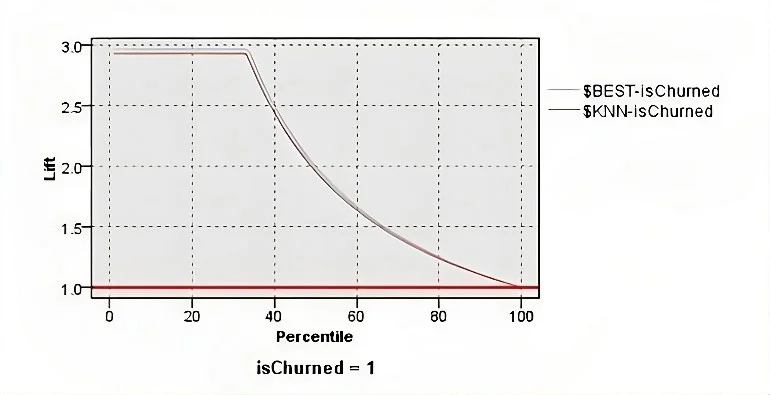
Three classifiers predict churn. k-nearest neighbor gives the best overall accuracy, and its lift in the top 10% of customers stays above 2.5, well past the acceptance threshold of 2.
| Method | Lift (top 20%) | Accuracy |
|---|---|---|
| CHAID decision tree | 2.9 | 83.95% |
| Perceptron neural network | 1.6 | 70.79% |
| k-nearest neighbor (k = 1) | 2.5 | 97.33% |
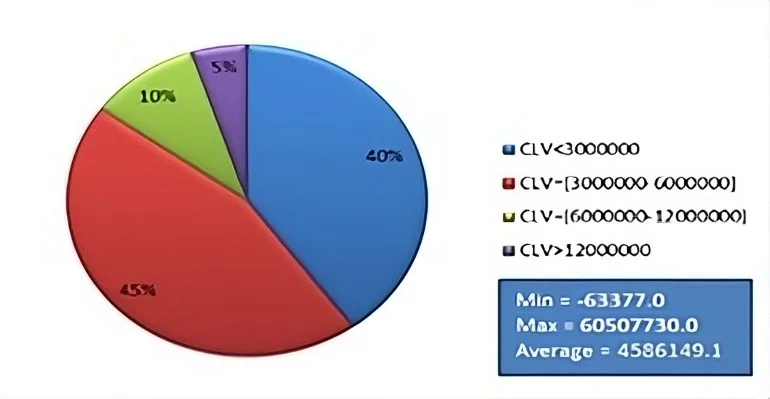
| CLV segment | Customers |
|---|---|
| CLV < 3,000,000 | 40% |
| 3,000,000 – 6,000,000 | 45% |
| 6,000,000 – 12,000,000 | 10% |
| CLV > 12,000,000 | 5% |
Takeaways
- Cloud infrastructure provides the scale to mine large customer datasets quickly and in parallel.
- Oversampling the rare churn class to a 1:2 ratio gives classifiers a usable signal on imbalanced data.
- k-nearest neighbor (k = 1) reaches 97.33% accuracy with a lift above 2.5, making it the most reliable churn predictor tested.
- Combining churn probability with lifetime value lets a business target retention spending at the customers worth keeping.
BibTeX
@INPROCEEDINGS{10496623,
  author={Sirjani, Mohammad Sadegh and Mousavi, Seyed Amir and Sadeghi, Mostafa},
  booktitle={2024 10th International Conference on Artificial Intelligence and Robotics (QICAR)},
  title={Data Mining and Cloud Computing for Customer Pattern Analysis and Value Maximization},
  year={2024},
  volume={},
  number={},
  pages={339-344},
  keywords={Industries;Cloud computing;Computational modeling;Switches;Probability;Predictive models;Turning;Data mining;Software engineering;Customer pattern analysis;Cloud computing;optimization},
  doi={10.1109/QICAR61538.2024.10496623}
}