Deadlines at the Edge
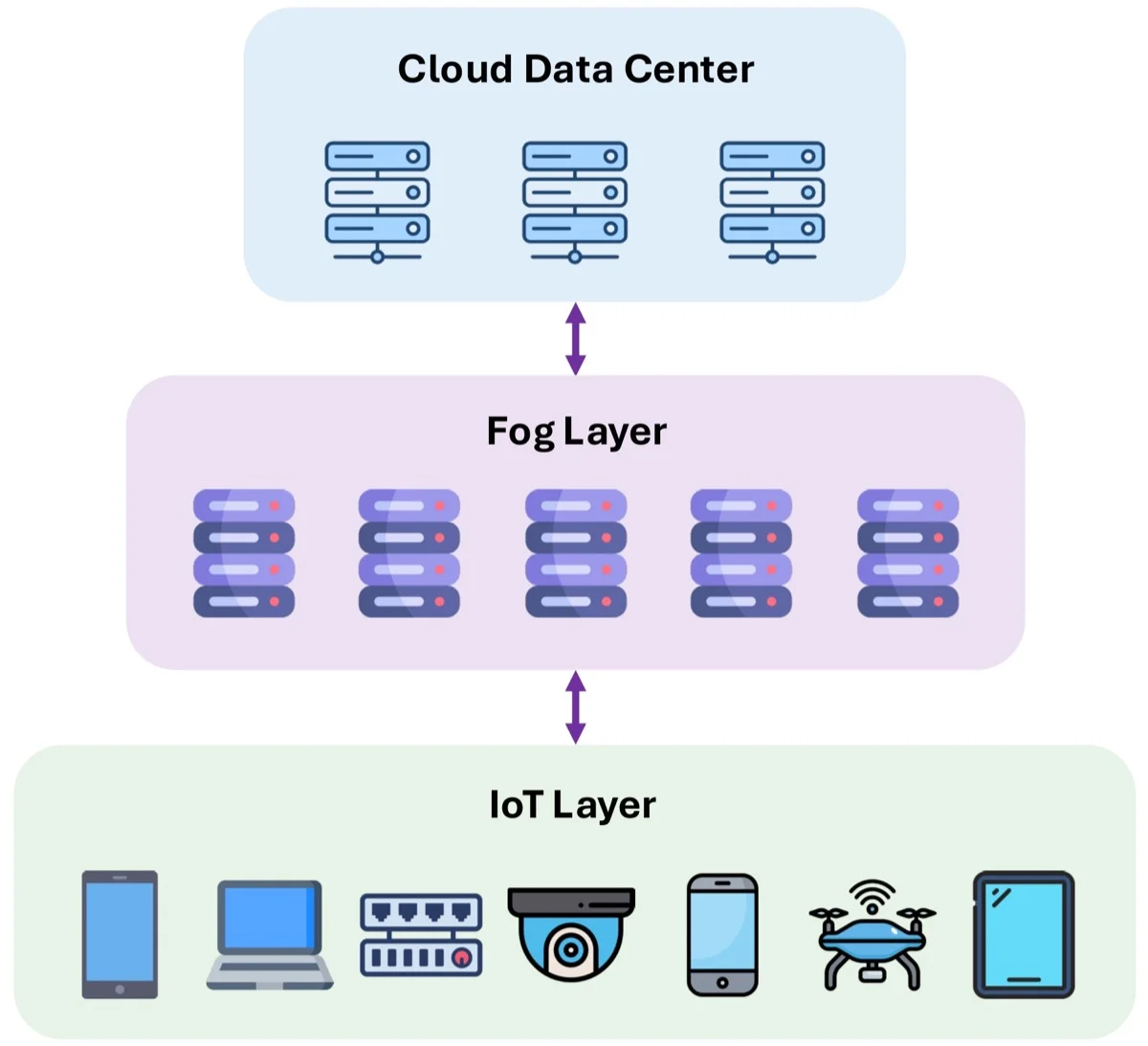
Time-sensitive IoT applications such as e-health, smart grids, and smart traffic need fast, deadline-aware responses. Fog nodes bring computation closer to devices, but their limited, heterogeneous resources make task scheduling the bottleneck.
Abstract
The rise of Internet of Things (IoT) devices has led to the development of numerous time-sensitive applications that require quick responses and low latency. Fog computing has emerged as a solution for processing these IoT applications, but it faces challenges such as resource allocation and job scheduling. Therefore, it is crucial to determine how to assign and schedule tasks on Fog nodes. This work aims to schedule tasks in IoT while minimizing the total energy consumption of nodes and enhancing the Quality of Service (QoS) requirements of IoT tasks, taking into account task deadlines. This paper classifies Fog nodes into two categories based on their traffic level: low and high. It schedules short-deadline tasks on low-traffic nodes using an Improved Golden Eagle Optimization (IGEO) algorithm, an enhancement that utilizes genetic operators for discretization. Long-deadline tasks are processed on high-traffic nodes using reinforcement learning (RL). This combined approach is called the Reinforcement Improved Golden Eagle Optimization (RIGEO) algorithm. Experimental results demonstrate that RIGEO achieves up to a 29% reduction in energy consumption, up to an 86% improvement in response time, and up to a 19% reduction in deadline violations compared to state-of-the-art algorithms.
RIGEO Framework
Fog nodes whose mean traffic exceeds the network-wide median are labeled high-traffic; tasks below the 25th-percentile deadline are short-deadline. Each class goes to the scheduler that suits it.
| Tasks | Fog nodes | Scheduler |
|---|---|---|
| Short deadline | Low-traffic FNs | IGEO |
| Long deadline | High-traffic FNs | Reinforcement learning |
Require: task T with deadline D, fog nodes F = {f1, ..., fn}
Ensure:  scheduled and processed task

 1  LowTrafficFNs ← ∅, HighTrafficFNs ← ∅
 2  for each f ∈ F do
 3      if f.traffic < traffic_threshold then
 4          add f to LowTrafficFNs
 5      else
 6          add f to HighTrafficFNs
 7  if T.deadline < deadline_threshold then
 8      f ← SELECT(LowTrafficFNs)
 9      result ← IGEO_PROCESS(T, f)
10  else
11      f ← SELECT(HighTrafficFNs)
12      result ← RL_PROCESS(T, f)
13 return resultReinforcement Learning for Long Deadlines
A table-based policy schedules long-deadline tasks on high-traffic nodes. It maintains a communication-preference matrix P and updates it online as each task in the batch is processed.
- State. The index of the most recently assigned high-traffic fog node; the first state is drawn uniformly from the high-traffic set.
- Action. Greedily pick the high-traffic node with the highest learned preference P(s, f) from the current state.
- Reward. When the task meets its deadline, P(s, a) scales up by 10%; on a violation it scales down by 10%, clipped to [0, 1].
- Transition. The state moves to the assigned node, so the policy adapts as tasks in the batch arrive.
IGEO: Discrete Golden Eagle Search
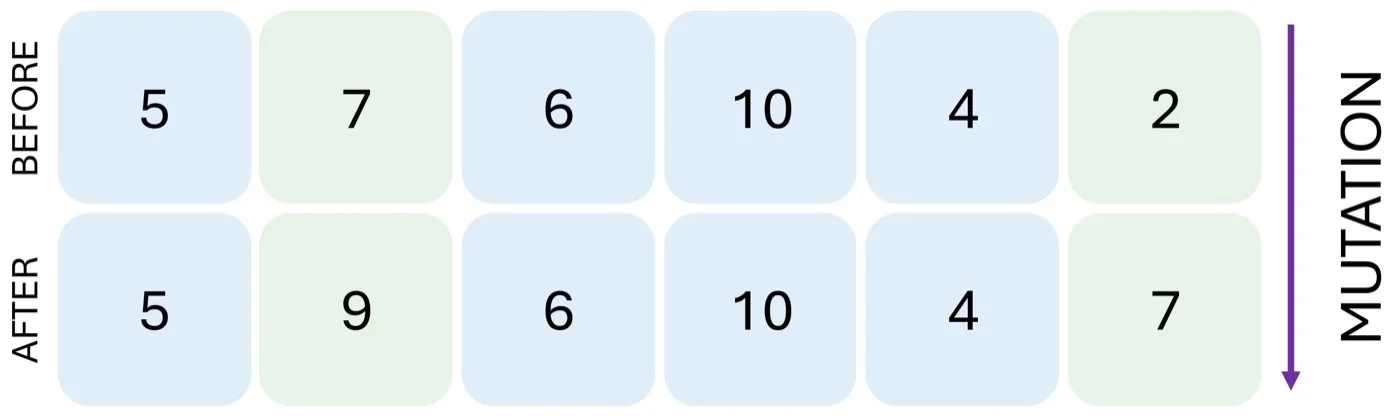
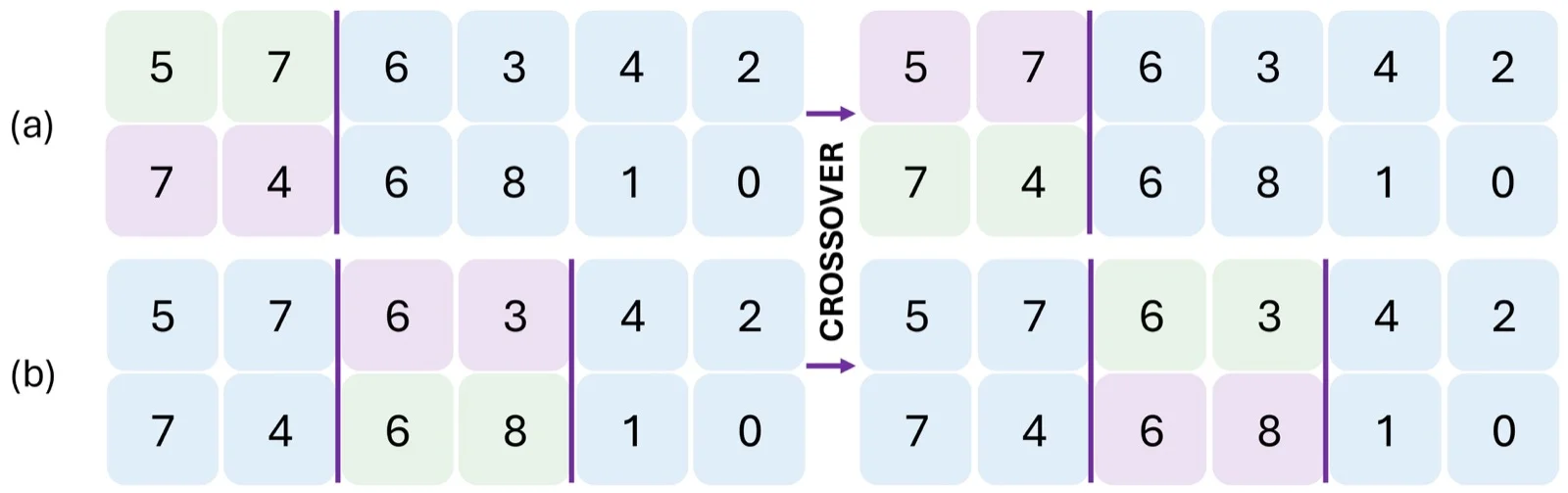
Golden Eagle Optimization balances cruising (exploration) and attacking (exploitation). Task scheduling is discrete, so IGEO replaces the continuous position update with genetic operators: mutation when the step vector favors exploration, crossover when it favors exploitation.
Simulation Setup
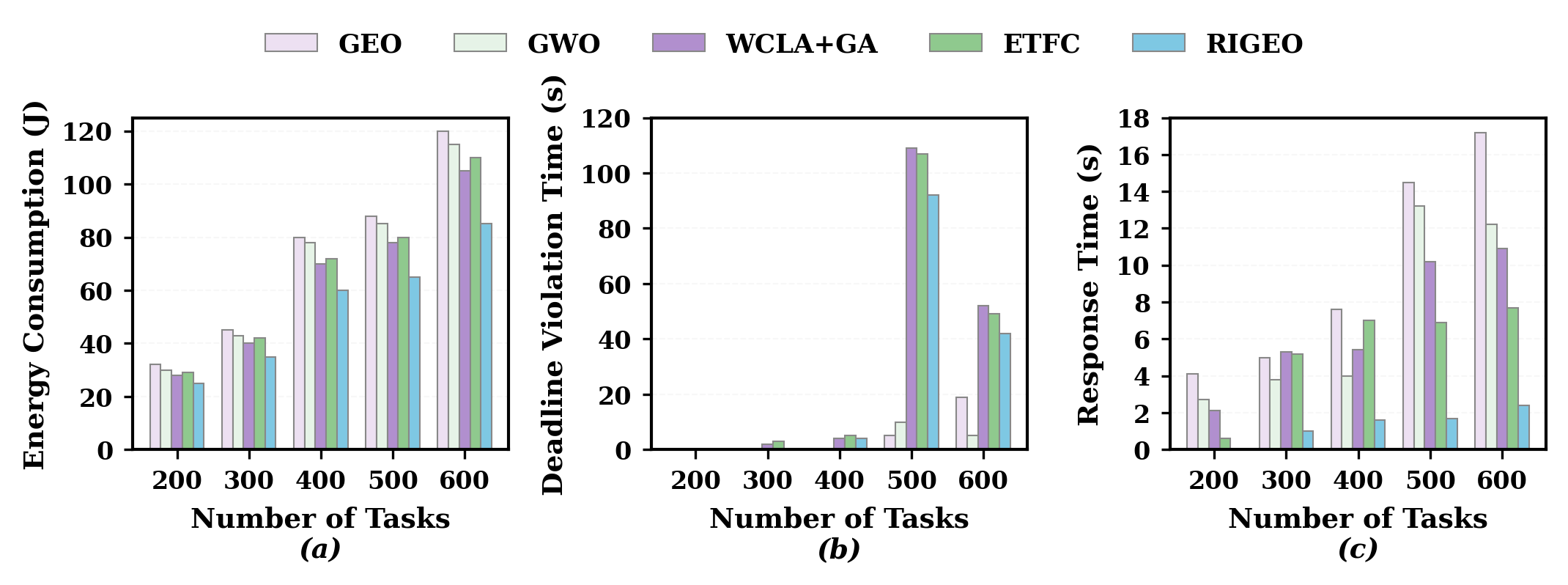
Workloads of 200–600 tasks are scheduled on 20 heterogeneous fog nodes over 10 time slots, averaged over 50 Monte Carlo runs. Baselines are GEO, GWO, WCLA+GA, and ETFC.
| Parameter | Value |
|---|---|
| Workload | |
| Fog nodes (m) | 20 |
| Network topology | Full mesh |
| Task loads evaluated | 200, 300, 400, 500, 600 |
| Time slots (T) | 10 |
| Monte Carlo runs | 50 |
| Population size (Npop) | 50 |
| Iterations per batch (Niter) | 2 |
| Traffic history length | 200 steps |
| Max node traffic load | 100 units |
| Fog nodes | |
| CPU capacity (Cj) | U{81, …, 100} units |
| Memory (Mj) | U{5, …, 16} GB |
| Energy rate (εj) | U{3, 4, 5} + U[0, 1) J/cycle |
| Energy harvest (hj) | 0.003 |
| Cost rate (κj) | U[0, 1) |
| QoS throughput (θj) | U[0.5, 1.5] |
| Network | |
| Task data size (si) | ≤ ci × 0.5 ≈ 2.5 MB |
| Link bandwidth (Bjk) | ≥ 1 Gbps (wired LAN) |
| Propagation delay (δjk) | < 0.1 ms (co-located) |
| Communication overhead | Negligible (≪ Ei) |
| Thresholds | |
| Deadline threshold | 25th percentile |
| Traffic threshold | Median of node mean |
Results
RIGEO distributes tasks more evenly across fog nodes, lowering energy use, deadline violations, and response time across all task loads.
| Metric | RIGEO | vs. |
|---|---|---|
| Energy consumption | 29% lower | GEO |
| Energy consumption | 26% lower | GWO |
| Response time | 86% faster | GEO |
| Response time | 80% faster | GWO |
| Deadline violation | 19% lower | WCLA+GA |
| Deadline violation | 14% lower | ETFC |
Takeaways
- Splitting fog nodes by traffic and tasks by deadline lets each scheduler work where it is strongest.
- IGEO discretizes Golden Eagle Optimization with mutation for exploration and crossover for exploitation, fitting short-deadline tasks on low-traffic nodes.
- A lightweight table-based RL policy handles long-deadline tasks on busy nodes without meta-heuristic overhead.
- At 600 tasks, RIGEO cuts energy by up to 29%, response time by up to 86%, and deadline violations by up to 19% against state-of-the-art baselines.
Conference Slides
The talk presented at SATC 2026. Use the arrow keys, the buttons, or swipe to move between slides.
BibTeX
@inproceedings{sirjani2026optimizing,
  author={Sirjani, Mohammad Sadegh and Ahmad, Mohammad and Mousavi, Amir and Nourbakhsh, Erfan and Nguyen, Khoa},
  title={Optimizing Task Scheduling in Fog Computing with Deadline Awareness},
  booktitle={2026 IEEE 2nd International Conference on Secure IoT, Assured and Trusted Computing (SATC)},
  address={Houston, TX, USA},
  year={2026},
  pages={1-5},
  doi={10.1109/SATC69565.2026.11542230}
}