SecVanet: Provably Secure Authentication Protocol for Sending Emergency Events in VANET
Trusted Emergency Alerts on the Road
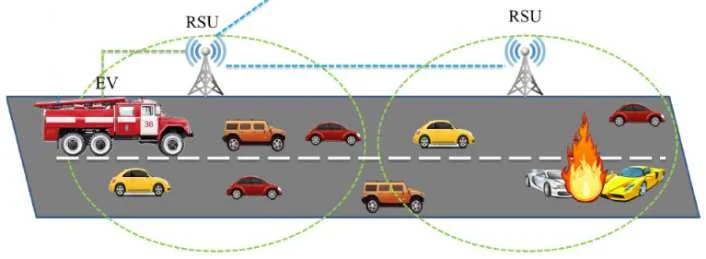
When an accident happens, vehicles warn the network and call emergency vehicles through roadside units. The channel is public, so an attacker could eavesdrop, tamper with messages, or fake an accident and send ambulances to the wrong place.
Abstract
Recently, the number of accidents resulting in irreparable damages like death has risen due to the increased number of vehicles worldwide. Vehicular ad hoc network (VANET) is a new technology for enhancing road safety, reducing traffic load, and providing emergency services. Vehicles can send warnings in a network to announce accidents and seek help from emergency vehicles. Security and privacy are now significant concerns in developing vehicular ad hoc networks despite the many advantages of VANET. The communication channel in this network is public and insecure, so there is concern about eavesdropping, message manipulation, and impersonation, which creates significant risks. For this reason, a safe and efficient protocol is proposed in this article to ensure data security in VANET. The security of the proposed protocol has been proven by the Scyther tool. The security analysis performed on the protocol also shows that the proposed protocol is resistant to many attacks and meets various security requirements. We also evaluated the performance of the proposed protocol in terms of computational complexity and showed that the proposed scheme has less computational complexity than similar schemes.
Registration
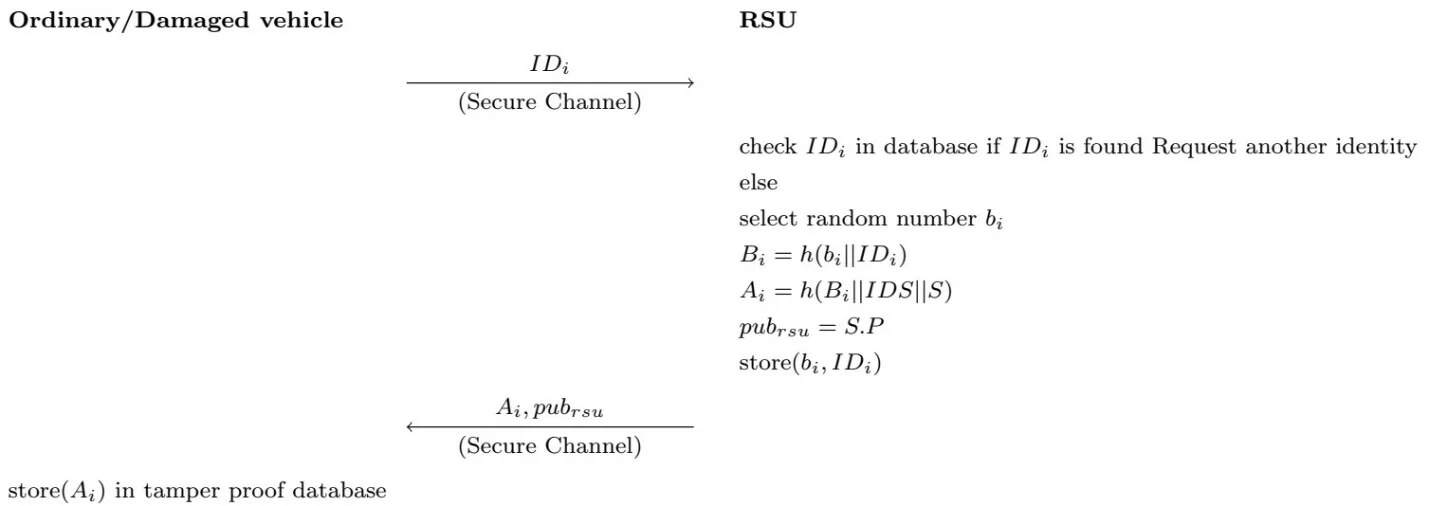
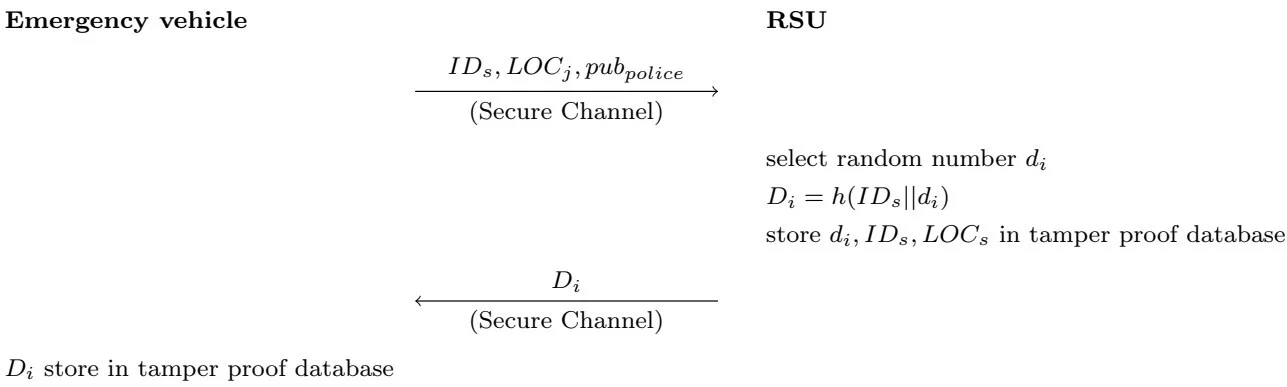
Before any emergency, ordinary vehicles and emergency vehicles register with the RSU over a secure channel. The RSU stores their credentials, and each vehicle keeps its own in tamper-proof memory.
Authentication and Key Agreement
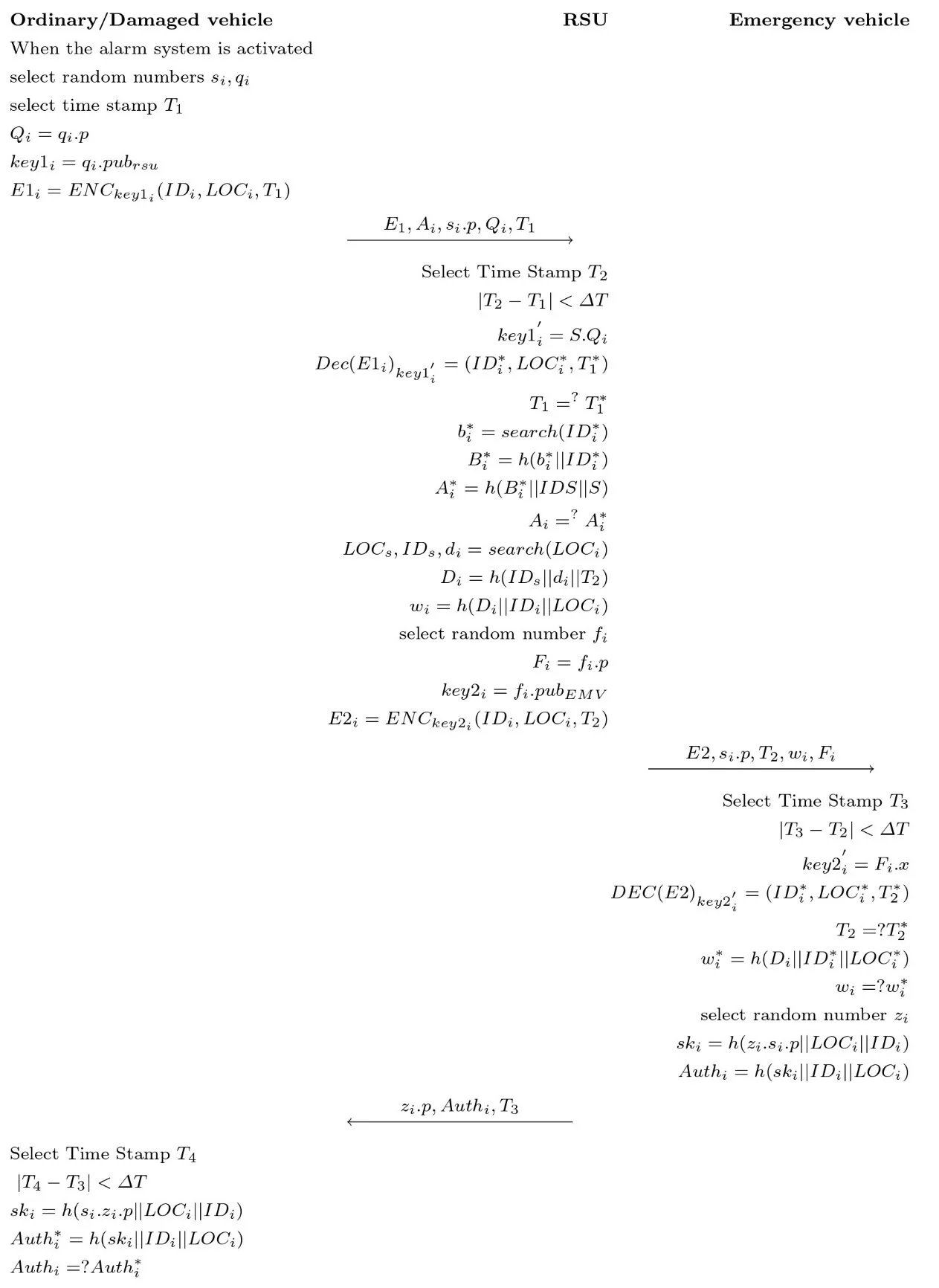
When the alarm fires, the damaged vehicle sends an encrypted, timestamped alert to the RSU. The RSU verifies it, finds an emergency vehicle in the same area, and forwards the event. The emergency vehicle and the damaged vehicle then authenticate each other and agree on a session key.
Security Analysis
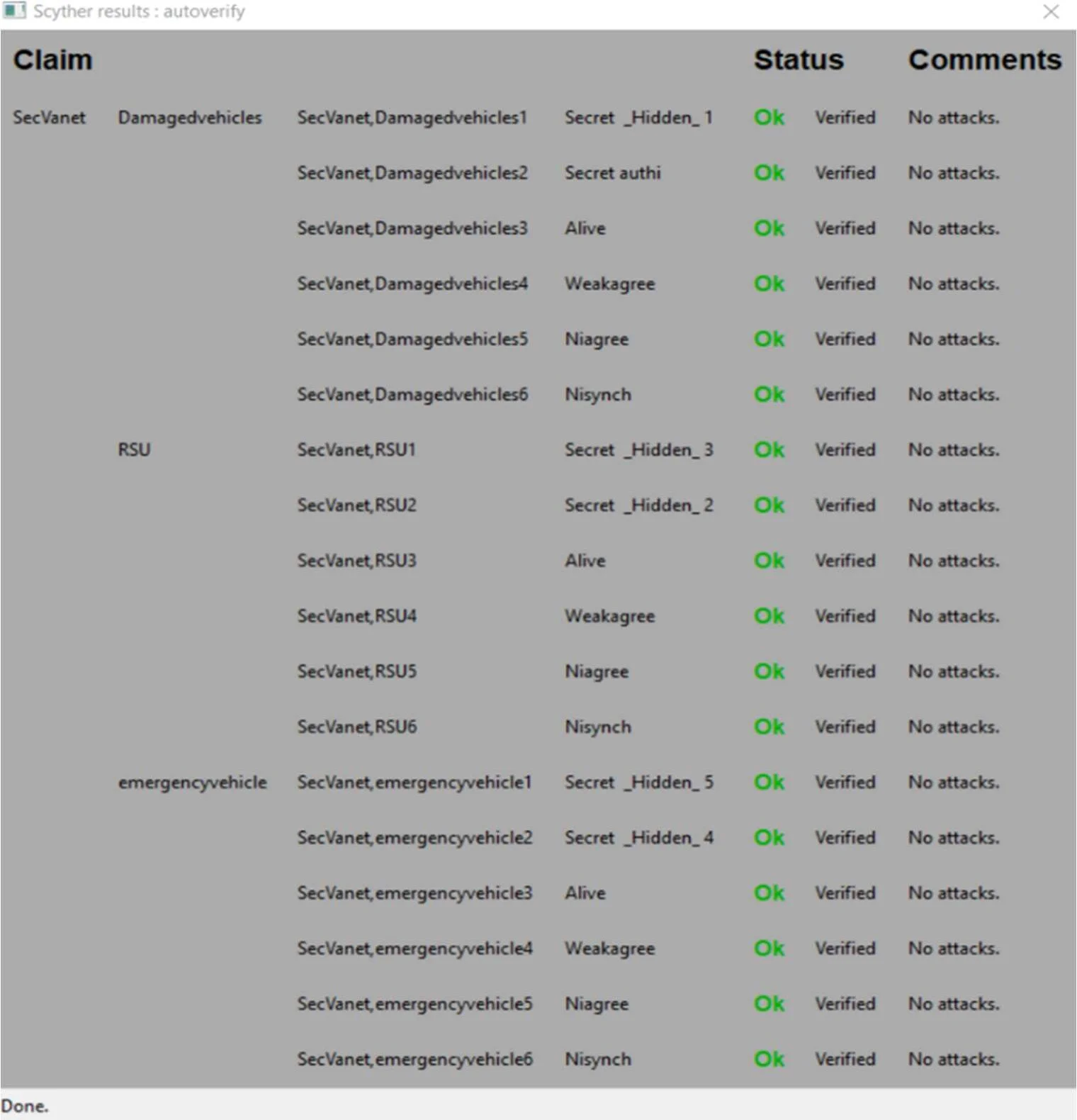
An informal analysis shows which attacks SecVanet resists, and the Scyther tool verifies its claims formally.
- Perfect forward secrecy. The session key depends on fresh random values under ECDH, so leaked long-term keys do not expose past sessions.
- Mutual authentication. Every party checks the received authenticators before continuing.
- Replay resistance. Timestamps are checked for freshness at every step.
- Stolen-verifier resistance. Reading the RSU or vehicle memory does not let an attacker rebuild the session key.
- Impersonation resistance. Strict mutual authentication drops the connection whenever a check fails.
- Known-session temporary information. A long-term secret in the session key keeps it safe even if the random values leak.
Computation Cost
Operation times come from Abbasinezhad-Mood et al.: ECC point multiplication (TM) 2.2265 ms, hash (TH) 0.0023 ms, symmetric encryption (TSE) 0.0046 ms, sign (TS) 3.85 ms, modular exponentiation (TE) 3.85 ms, and Chebyshev map (TC) 1.113 ms.
| Scheme | Total computation | Time (ms) |
|---|---|---|
| Scheme [12] | 5TS + 6TH + 2TSE | 19.273 |
| Scheme [15] | 25TC + 29TE | 139.475 |
| SecVanet | 7TM + 9TH + 4TSE | 15.623 |
Takeaways
- SecVanet authenticates damaged vehicles, the RSU, and emergency vehicles before an emergency event is trusted, blocking fake accident reports.
- Scyther verifies every claim for all three roles with no attacks found.
- The protocol resists replay, stolen-verifier, impersonation, and known-session-specific temporary information attacks, and provides perfect forward secrecy.
- At 15.623 ms of computation, it is lighter than the compared schemes at 19.273 ms and 139.475 ms.
BibTeX
@INPROCEEDINGS{10433027,
  author={Mousavi, Seyed Amir and Sirjani, Mohammad Sadegh and Razavi, Seyyed Javad Bozorg Zadeh and Nikooghadam, Morteza},
  booktitle={2023 14th International Conference on Information and Knowledge Technology (IKT)},
  title={SecVanet: provably secure authentication protocol for sending emergency events in VANET},
  year={2023},
  volume={},
  number={},
  pages={86-91},
  keywords={Resistance;Protocols;Vehicular ad hoc networks;Telecommunication traffic;Road safety;Computational complexity;Accidents;Authentication;Privacy;Key agreement;VANET;Scyther Tool},
  doi={10.1109/IKT62039.2023.10433027}
}